
British Columbia's Ancient Rainforests - A Global Treasure !
Rare and Majestic:
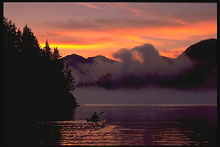 Temperate forests have been identified by the World Resources Institute as the most endangered forest type on the planet. Temperate rainforests only ever covered 0.2% of the world's land surface originally covering western coastal areas of Norway, Ireland, Scotland, Turkey, New Zealand, Tasmania (Australia), Chile and the west coast of North America, extending from northern California through British Columbia to southern Alaska. Within a narrow band of the rugged coast of British Columbia lies one of the most ecologically important forests in the world. It is home to a quarter of the world's remaining ancient temperate rainforest.
 |
|
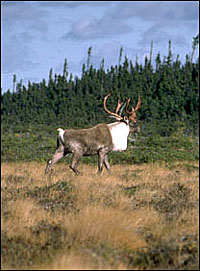
Tragically, 50% of BC's ancient rainforests have already been destroyed. Only 20% of the original large pristine rainforest valleys on the coast of BC remain intact. Logging is planned for the majority of these in the next 5-10 years. The BC Ministry of Environment has concluded that one out of eight species in the province is at risk of extinction, and that logging is one of the major threats endangering species. Most of Canada's species at risk are found within two forest zones which have been degraded with high rates of clearing and fragmentation, BC's temperate rainforests is one of those areas.
The remaining ancient temperate rainforests are vital for species habitat, climate regulation and bio-diversity. The biological riches of areas such as the Great Bear Rainforest, Clayoquot Sound and Haida Gwaii continue to be under threat.
"World Class Logging"
Ninety percent of logging in BC is of ancient forests and 97% of
logging in the temperate rainforest continues to be by clearcutting.
This is contrary to public perception that clear-cutting is a thing of the past.
| Clearcutting causes two kinds of fundamental damage, one long lasting, the other permanent. The long lasting damage is to the soil, the permanent damage is to the biological diversity. (Dr. C. Pielou, eminent BC scientist) |
||
The BC government and logging industry claim that their logging standards are "World Class" although BC still has no Endangered Species legislation. The BC government has eroded forest practices legislation with over 1000 changes to the Forest Practices Code since its introduction in June of 1995.
Jobs and Communities
Natural Resources Canada estimates that there are 337 forest-dependant communities in Canada. A further 1,294 are felt to have some reliance on the logging industry. This information may not be completely up-to-date as a number of the listed communities have already seen mill closures over the past 3-5 years.
Since 1997, 21,500 people have lost their jobs in the BC logging industry. Eight BC mills permanently closed in 1997 and 1998. It is estimated that a further 30,000 people will lose their jobs in the logging industry in the coming years. BC has one of the worst jobs:volume of wood cut ratios in the industrialized world. High tech is expected to surpass logging in terms of revenue generation by 2004.
BC has one of the worst ratios of employment to volume of wood cut in the world, especially among industrialized countries. BC generates only one third of the jobs that the United States does and one half of the jobs that Sweden does for the same amount of wood cut. BC’s poor employment ratio can be attributed to:
- high levels of mechanization,
- minimal manufacturing and processing within BC, and
- the increase of raw log exports.
There has been a dramatic increase in raw log exports over the past three years. The export of logs and minimally processed wood from coastal communities also exports community jobs. If BC were to employ the same number of people/volume wood cut that Washington State does, it could maintain the number of people employed in the logging industry and reduce the amount of forest it cuts fivefold. If it were to replicate Switzerland's efforts we could reduce the amount of wood cut by 10. Instead of shipping wood across the US border to be made into window and door moldings, furniture and other value added products we could supply local mills and manufacturers with the wood supply required for a vibrant manufacturing sector in BC.
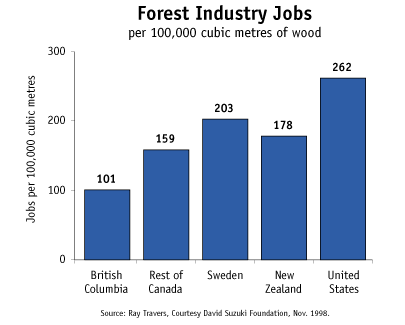
Table 1. BC's job to volume of wood cut ratio is one of the worst in the world.
First Nations and resource-based communities that rely on the rainforest and its fisheries are profoundly affected by clear-cutting and over-cutting. Logging continues on aboriginal lands, in spite of the fact that First Nations in BC have never ceded title of their traditional territories. Traditional and commercial fisheries are increasingly restricted as salmon stocks decline. Scientists attribute 30% of the decline in salmon stocks over the past two decades to the destruction of salmon habitat. Industrial logging undermines opportunities for local communities to develop ecologically and economically sustainable economies. Options for community controlled, sustainable forestry operations, community fishing or tourism operations are severely impacted by industrial logging.
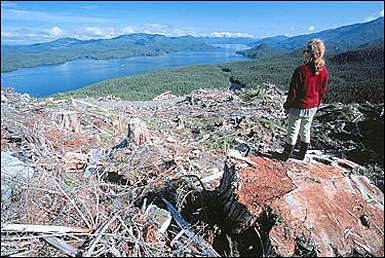
It's difficult to market a vibrant tourism economy with a viewscape like this